PoE2 Grand Expedition Farming Guide — Runes, Logbooks, Tablets & Divines per Hour
PoE2 0.5.5 Expedition farming guide: Grand Expedition rune pathing, tablet breakpoints, Liquid Verisium rerolls, logbook sustain, budget and jackpot builds.
Quick Answer: Is Grand Expedition the Best Farm in 0.5.5?
Here is the straight answer: once your routing is practiced and your build clears the damage gate, Grand Expedition is a T0 farm in Patch 0.5.5. Veteran farmer testing puts the lean budget route at 35+ divines per hour, while fully juiced jackpot setups have been community-reported at 60+ divines per hour in mid-September 2026 testing.
That ceiling is real, but it is not free. Expedition taxes three things most farms do not: build power — the last Remnant in a long rune chain produces some of the tankiest rare packs in the endgame; routing practice — a sloppy explosives chain can halve your loot, and good pathing is a learned skill, not a checkbox; and upfront investment — Tablets, Waystones and Verisium rerolls cost currency before the map ever pays out.
Run it if: your build kills high-density rare packs comfortably, you enjoy a five-to-ten-minute routing puzzle per map, and you can stomach rolling before you earn. Skip it if: you play melee into one-shot mechanics, want zero-input alch-and-go farming, or need guaranteed flat income with no variance. Everything below — the Rune tier list, the exact Tablet breakpoints, the Liquid Verisium rules — is built to move you from “bleeding currency on explosions” into the 35+ div/hr bracket as fast as possible.
What Changed in 0.5.5: Expedition Goes Core
The first thing to get straight is that Expedition is no longer a side event. According to the official 0.5.5 patch notes, Farrow, Dannig and the whole Kalguuran excavation mechanic are now a permanent core Atlas mechanic, including in Standard League, and first shows up as early as Act 4 of the campaign. The supply of Logbooks and Remnants in the economy now flows year-round; for the wider event-league context, see our 0.5.5 event league guide.
The rest of the rework, in plain language:
- Denser encounters in practice (community-tested). Farmers running 0.5.5 zones report that a single area can now contain several Remnants and multiple Expedition sites, which makes reading a layout before placing your first charge more valuable than it was in the Aldur-only window. This is a post-launch field observation rather than a line in the notes.
- Aldur’s Saga modifiers live on inside Grand Expeditions. Per the official notes, the Aldur’s Saga item itself cannot be obtained outside the Runes of Aldur league, but its special modifiers can now appear naturally on Grand Expeditions opened from a Logbook in Standard and Forbidden Rites. The exact Saga can no longer be targeted on demand, so consistency is lower than in the Aldur window, but the ceiling of an individual Grand map is intact.
- Expedition Tablets. A new Tablet type exists specifically to force and scale Kalguuran content in your map device. The breakpoints are exact and covered below; they are the single biggest lever in the modern setup.
- Liquid Verisium. Sold by the NPC Farrow for 600 Verisium, this consumable rerolls any Remnant into a random new one. For the Verisium economy itself — farming it, spending it, and what Farrow offers — see our Verisium Runeforging guide.
How Expedition Works: Normal Encounters vs Grand Expeditions
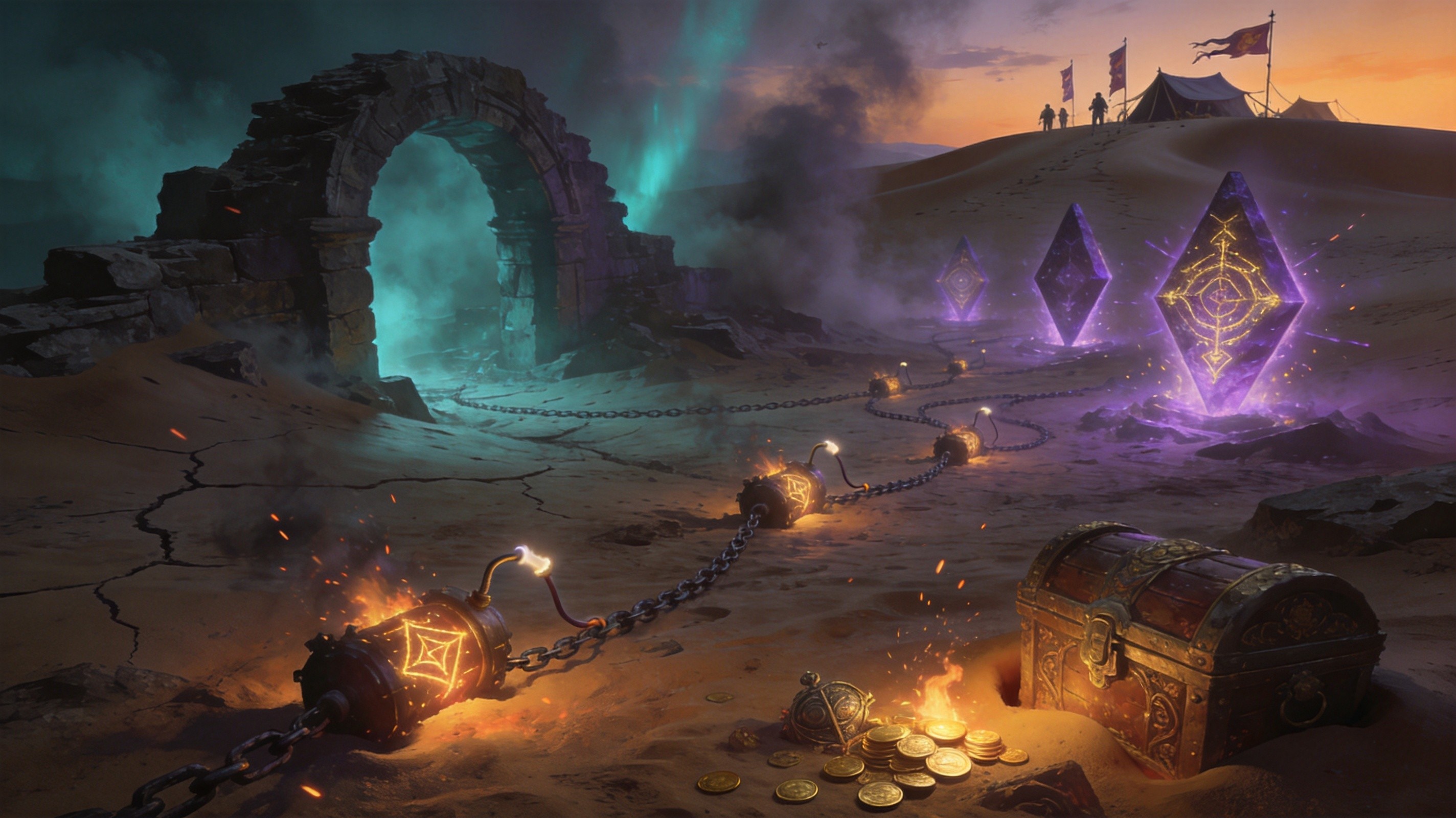
The base loop is simple. You arrive at an excavation site, place a chain of explosive runes across the ground, and route that chain through diamond-shaped Remnant markers. Detonate, then kill the Runic monsters that wake up. Each Remnant the chain touches adds runic modifiers to the encounter and scales its rewards; place badly and you wake monsters without paying them out.
In the ocean biome there are two flavors of map, and confusing them is the number one mistake new Expedition farmers make:
| Map type | Visual cue | What you get | Role in your loop |
|---|---|---|---|
| Normal Expedition map | Standard map | At least one guaranteed normal Expedition encounter | Logbook sustain — run cheap and fast |
| Grand Expedition map | Whirlpool icon | One massive Remnant chain | Profit map — high investment, high payout |
The farming loop is therefore a two-speed engine: spam cheap normal maps to fish for Logbook drops (a Logbook is the ticket that opens a Grand Expedition), convert each Logbook into a scouted, rolled, high-investment Grand Expedition, then reinvest the payout into Tablets, Waystones and Verisium. You do not farm divines in the sustain maps — you farm the permission slip to farm divines.
Atlas Tree & Master Setup
Biome choice — Desert first. Desert grants additional monster effectiveness plus extra rare-monster modifiers, which compound with runic scaling harder than any other biome. It is the default for anyone whose build can survive it. If your character is undergeared, drop to Forest, which meaningfully lowers the difficulty of the Runic packs at the cost of top-end payout.
Atlas notables to path for: Additional Remnant per Expedition (more markers per chain, always take), a Power-Rune-chance notable (Power is the strongest purple Rune in the game, and investment toward more Power Runes pays for itself every map — check the exact node text on your Atlas tree), Extra Runic Modifiers, and Additional Explosives along the path so longer chains reach more Remnants without detours. Skip the Hives cluster and the small currency nodes that pull you off the Remnant path — every passive not spent on chain length, Rune quality or Remnant count is profit lost.
Master: Jado. His four mandatory nodes are Unexpected Missions, Eastern Knowledge, Partial Translations and Kjeen Appraisal. If your build is fragile — particularly when attempting one-portal, six-affix Grand maps — swap to Doryani and take Stitch the Flesh, which grants an extra revive: a payout tax in master choice that avoids losing a double-digit-divine entry fee to one bad pack.
Expedition Tablets: Exact Stacking Breakpoints
Since the 0.5 rework, the map device’s empty Tablet slots inject random non-Tablet league content into your maps; filling the slots instead focuses the map on the league content you choose. Expedition Tablets are how you force the mechanic this guide is about. Two things to know before the table. First, the slot rules come from community-tested map-device behavior rather than the patch notes: community testing holds that a Waystone needs at least 6 affixes to expose 3 Tablet slots, and a City Map (rolled with the Industrial Improvements modifier) provides a 4th slot — check the live affix tooltips on your own stones, since these values sit outside GGG’s published notes. Second, the notes themselves settle the supply side: Expedition Tablets drop only in Standard and the Forbidden Rites league — they cannot be obtained in the Runes of Aldur league, and 0.5.5 also added new Tablet mods (explosive area of effect, Logbook quantity from Runic monsters, extra ice-encased bosses, extra Verisium Sentries). If the slot and affix rules are new to you, our Waystone system guide walks through the full mechanic.
The official patch-notes breakpoints for stacking Expedition Tablets are exact — learn them:
| Tablets | Effect |
|---|---|
| 1 | Adds one Kalguuran Expedition to the map |
| 2 | Adds one Verisium Remnant + 35% increased Kalguuran Expedition density (more Chests, Monster Flags and Verisium Remnants at the site) |
| 3 | Adds a second Expedition encounter — two expedition sites in one map |
| 4 | Adds another Verisium Remnant + another 35% increased Kalguuran Expedition density (the 4th slot itself is the community-tested City Map case noted above) |
How to play the breakpoints: 2 Tablets is the low-complexity sweet spot — you get the density multiplier and the bonus Remnant with zero added routing burden, and it is where the budget route and most default farmers live. 3 Tablets demand a second clear — two expedition sites mean two chains to place and defend, and if reading the second site bloats your map time, your divines-per-hour falls despite the extra content, so practice before you commit. 4 Tablets are for good-layout City Maps only — the extra Verisium Remnant is excellent, but the entry cost and clear-time requirement make it a jackpot-route tool, not a daily driver.
Supply warning — early-league snapshot. Expedition Tablets were extremely rare at the opening of the Forbidden Rites window: community snapshots recorded roughly 700 Expedition Tablet listings versus 10,000+ Ritual or Abyss Tablets on the trade house, with uncrafted examples at one point priced above 1 divine. Treat those figures as a season-opening snapshot rather than a current price — supply normalizes as the league matures and the economy shifts.
Tablet affix priority. Best-in-slot is +2 random map modifiers on the Tablet; community experience suggests capping what you pay for a single best-in-slot Tablet at around 10 div, while triple-ideal rolls can cost far more. The secondary tier is monster effectiveness, increased rares and item rarity. On a budget, take any two of three from extra rares, monster effectiveness and monster rarity — a two-of-three Tablet does real work for a fraction of what top-tier rolls cost. Tablet crafting follows the same endgame rolling rules as everything else in the map device; our complete crafting guide covers the mechanics when you start pushing your own rolls.
Waystone Rolls
Eight affixes is the target on a Grand Expedition Waystone — more affixes mean more slots and more scaling on everything the chain touches. Affix priority runs monster effectiveness > monster rarity > item rarity > pack size, and pack size is the one popular rolling affix you actively dodge: it adds bodies without adding the rare-monster quality that runic rewards scale against. A widely-reported community practice is to use an Omen of Chaotic Quantity to block pack size before corrupting, which sharpens the outcome considerably.
| Tier | Community roll shorthand | Approx. cost (community snapshot) | When to use |
|---|---|---|---|
| Budget | 20 / 30 / 30 | A few exalts per stone | Sustain-into-budget Grand maps |
| Mid | 30 / 40 / 40 | Roughly 2–3 div each | Daily-driver jackpot attempts |
| High-investment (7+ slots) | 30 / 40 / 50 | Up to roughly 6 div each | Perfect-layout, 4-Tablet City Maps |
The three-number shorthand above is community jargon, not an in-game label: farmers quote the magnitude of the three scaling roll tiers they buy on the stone in order. Exact wording and axis names vary by source — read the actual affixes on the Waystone before you buy, and treat the numbers as roll magnitudes to shop for, not vendor-fixed values.
These are veteran rolling habits, not fixed vendor prices — the trade house moves daily, so price-check before you buy in bulk.
Remnant Anatomy & the Rune Tier List
Every Remnant has three components, and a good router reads all three before the first charge goes down: an instant reward paid out when the chain reaches it (ranging from a few exalts’ worth of currency up to mirror-tier jackpots); Rune slots, where more slots mean the Runic monsters in scope are substantially tankier and drop substantially better loot; and propagation — a yellow-bordered Rune is inherited by every Remnant that comes after it in the chain, making propagation Runes the most valuable things on the board early because their effect compounds across every later marker.
Rune Tier List
| Tier | Runes | Why |
|---|---|---|
| SS | Opulent | The only gold Rune. Adds rarity to all monsters in scope. If an Opulent is on the board, you reroute the chain to reach it. No debate. |
| S | Power, Death, Bond, Oath | Purple powerhouses. Power multiplicatively amplifies the effect of every other Rune in the chain, making it the best anchor after Opulent. Note for 0.5.5: the Oath Rune no longer makes its monster damage-immune — it now grants increased Ward (and a raised Rarity bonus), so an Oath-scoped pack is dangerous rather than invulnerable. |
| A | Time, Rebirth | Rebirth is the only blue Rune worth prioritizing; Time earns its slot on long chains. |
| B | Other purple Runes | Fine filler; at 3–5 slot Remnants these are the ones you Liquid Verisium away. |
| C | Remaining blue Runes | Take only if the chain pathing is free. Never reroute for them. |
Two rules never change: same-name Runes do not stack, so you only need one copy of each powerhouse, and Opulent over everything — an early Opulent upgrades the entire payout of the map.
Pathing Strategy: Early, Middle and Late Chain
Routing is one skill with three phases, and the value function changes as the chain grows.
Early chain — propagation only. Hunt yellow-bordered propagation Runes and secure them first, even when the attached reward is small. An early Opulent or Power is worth grabbing for its own sake as well, since it colors every subsequent Remnant.
Middle chain — propagation and rewards together. Veteran routing guides credit each Remnant you hit with roughly 50% increased monster rarity on everything later in the chain (a community figure, not a tooltip), so by the middle of the route nearly every marker is worth taking as long as it does not cost a detour. Start respecting instant rewards now; a 1+ divine payout sitting on-route is never skipped.
Late chain — slot count is all that matters. The final, high-slot Remnant inherits all the propagated buffs accumulated before it and pays out the biggest pile of the map. Route the chain so the highest-slot marker lands last, and let the propagated Opulent, Power and rarity do the work.
Liquid Verisium Reroll Rules
Liquid Verisium is a reroll button for Remnants, and disciplined rerolling is where jackpot players separate themselves. As of 0.5.5 it can be applied to a Runic Remnant directly from your inventory (a pre-patch bug that blocked this is fixed). Veteran rules: bad 3- and 4-slot Remnants all get rerolled, with the single exception of a 4-slot Remnant carrying a guaranteed 1 divine reward, which pays for itself immediately; most 5-slot Remnants get rerolled unless the Rune combination is already Tier S; bad 6-slot Remnants get rerolled because slots without Runes to fill them are wasted potential; and minimum-slot maps are the safety net — Grand maps can roll “Remnants have minimum 5/6/7/8/9 Rune slots,” Liquid Verisium respects that floor, and on a minimum-7-slot map community testing treats any reward below 3 div as safe to reroll, because the slot floor keeps the replacement valuable.
Chests: What to Open, What to Ignore
Bright yellow currency chests are the fast-route workhorses — community reports place their divine drop chance at roughly 40%, and on a budget speedrun these are the only chests you detour for. Bright yellow equipment chests always contain an Exceptional item, and on ilvl 81/82 maps those can roll the valuable high-level bases, so open every one on-route. Dark chests are skipped unless they sit directly on the chain path. On a slow, high-juice run veteran farmers barely look at chests at all — the Remnant payouts dwarf them, and every second spent off the chain costs currency. One small 0.5.5 addition to watch for: a new Runeshape recipe on Expedition Remnants inside Logbooks now pays out 10 Chaos Orbs, so a Remnant carrying that recipe is always worth detonating on-route.
Budget vs Jackpot: Two Complete Setups
There is no single “best” Expedition setup — there is a variance-averse factory and a lottery ticket, so pick deliberately.
Setup A — Budget Route (community-reported 35+ div/hr)
| Component | Choice |
|---|---|
| Waystones | Cheap 20/30/30 rolls |
| Tablets | Budget item-rarity + monster-effectiveness Tablets (two-of-three affixes) |
| Chain priorities | Early Opulent/Power, bright yellow chests, high-slot end Remnant, 1+ div instant rewards |
| Routing | Zero detours |
| Rerolls | Conservative — only clearly dead Remnants |
Community-reported results: around 4 div per map at roughly 6 minutes per map, landing at 35+ div/hr, with effectively no jackpot variance. This is the grind that funds your gearing; for how it sits inside the wider endgame meta, see our currency farming tier list.
Setup B — Jackpot Route (60+ div/hr ceiling)
| Component | Choice |
|---|---|
| Tablets | +2 random map modifier Tablets at roughly 6–8 div each (ideal triple-stat rolls up to 20 div) |
| Waystones | 20/40/40 daily drivers and 30/40/50 for premium layouts |
| Logbooks | Scouted beforehand; only Logbooks fishing for 4+ Grand Expedition Rumors are run |
| Loot filter | Jewelry rares only |
| Rerolls | Aggressive Liquid Verisium use under minimum-slot protection |
Community-reported results: roughly 15 div average on a normal six-affix Grand map and roughly 35 div average on 7+ slot maps, with true jackpots headlined by Aldur’s Legacy (200+ div), Mageblood, Rite of Passage and Dialla’s Desire. The 60+ div/hr figure traces to widely-circulated Grand Expedition testing by Fubgun in mid-September 2026 — treat it as an experienced-player ceiling, not a league-start expectation.
Reading Rumors, Logbooks & Unique Maps
A Rumor is a clue fragment shown in the Logbook interface, and each one points toward a specific area type inside the Grand Expedition. High-investment runners only open Logbooks that show a 4+ Grand Expedition Rumor — the clue density is how you know the map is worth running on a 30/40/50 Waystone before the first charge.
A community-reported trick: repeatedly toggling certain consumables on and off in your inventory can cause the Logbook’s hidden Rumors to cycle into view. It is a community discovery rather than documented behavior, so use it while it works and do not rely on it surviving future patches.
| Unique Expedition map | Notes |
|---|---|
| Fallen Skies | The best of the bunch — Perfect Flux drops consistently, and you can use Vision of Paradise to double-open it |
| All That Glitters, Reflective Waters, Almost Paradise, A Good Fellow | The secondary uniques — run them opportunistically when the Rumor lines up and the roll is good |
Boss Rumors to recognize on a Logbook: Stardrinker, reached by farming Uthred (it drops the Runeseeker’s Call quest item, once per character; Uthred himself is covered in our ocean bosses guide); plus Origin of the Fall, The Last to Fall and End of the Circle.
Logbook Sustain: Feeding the Engine
Grand Expeditions only exist if Logbooks keep coming, and sustain is run at a deliberately different pace from the profit maps.
- Alch-and-go normal maps — or even magic maps. Investment here is wasted; you are fishing, not juicing.
- Focus entirely on the Expedition encounters. Other mechanics are ignored unless they sit directly on top of the site.
- Logbook drop chance scales with monster rarity. Rare Runic monsters drop Logbooks at a meaningful rate; normal monsters barely contribute. Let the rune chain do the killing.
- Stop at the boss. Do not full-clear — every extra minute in a sustain map is a minute not spent in a Grand map.
- Pair Abyss cheaply if you need rare density. The Ulaman Abyss currency chests in particular pay out exalts quickly and fill the rare-pack gaps on your route; our Abyss currency farming guide has the full setup.
Layout Tier List & Known Bugs
| Layout | Verdict |
|---|---|
| Frigid Bluffs | Strong PoE1-style Remnants. May roll crit immunity or damage-type immunities — read the affixes — but the payout is worth the entry |
| Lush Isle | Best experience in the pool; the leveling and gem-farming choice |
| Scorched Clay / Craggy Peninsula | Extra rarity objects; ideal for high-juice runs |
| Grazed Prairie | Injects wisps inside the map. Drag the wisps into your Remnant chain for multiplied drops — the cross-mechanic interaction with Wildwood is among the best in 0.5; see our Wildwood wisps guide |
| Exhumed Ruins | Completing the leyline objective grants a free Logbook — a strong sustain pick |
| Sloughed Gully | Poor layout; community reports suggest around 30% of Remnants can end up unreachable or missed |
| Barren Atoll | The worst layout. Community reports warn against opening a strongbox here — it has been linked to an invisible, invincible monster bug that can brick the entire expedition |
Community-known bugs to route around: do not mark an underground area and a Remnant simultaneously — runners report it can permanently stall the explosive chain’s progression and soft-lock the encounter. On Grazed Prairie, flying monsters may drift out of bounds; Firestorm-style area effects can still hit them through terrain, which is the reliable workaround. Neither issue is listed in the official notes, so treat them as community-reported until patched.
Build Requirements
Expedition punishes weak characters harder than almost any other farm. Community consensus also holds that most builds feel dramatically smoother with a Headhunter, but it is an accelerator, not a requirement — these three requirements, however, are non-negotiable:
- Raw damage. The monsters at the end of a high-slot chain are among the tankiest rares you can roll. This is a soft wall that most league-start builds simply cannot clear until their second or third upgrade cycle.
- Auto-target or ranged damage. The Mana Siphoner modifier forces fights into tight circles where melee faces eat everything. Totems, trigger builds, Spark, Arc Totem and Sparkcaller-style ranged casters massively outperform melee here.
- Ailment defense. Chill, freeze and shock removal is essential across long chains — a frozen character mid-detonation is a dead entry fee. The Kalguuran defensive toolkit, including runic wards, is explained in our Kalguuran skills & Runic Ward guide.
League-Start Ramp: The First 12–24 Hours
This is a community-reported early-league route, not a guaranteed income plan — early-economy numbers swing wildly.
- 0–12 hours: Clear the campaign and enter maps, picking up the Abyss nodes along the way. You are positioning, not earning.
- 12–24 hours: Run maps with two Waystone-chance irradiated Tablets. Craft the Abyss Tablets you drop — good affixes such as additional Rogue Exiles, twice the rewards and four additional pets sell for roughly 25–50 exalts each in the early window.
- Once your Atlas tree comes online: switch to white or blue T15 maps with Doryani’s revive as your safety net. Sell the valuable Remnants (community prices around 25+ exalts for good ones) and prioritize currency chests for raw liquid.
Some farmers have reported 100+ raw divines inside the first 12–24 hours on this ramp. Treat that as an outlier from players who practiced the route on prior knowledge — not as an expectation for your own first weekend.
FAQ
- Is Expedition still a “money printer” after 0.5.5? The Aldur’s Saga change cut consistency — you can no longer guarantee the exact god-map on demand — but the Grand Expedition ceiling and the 35+ div/hr budget route keep it solidly in T0. It prints on good routing, not on autopilot.
- Can I farm it without a Headhunter? Yes. Totem, trigger and ranged or grenadier builds clear everything, just more slowly. Headhunter removes speed friction; it does not unlock the mechanic.
- Does Expedition work in SSF? Reasonably well. Liquid Verisium costs only 600 Verisium from Farrow, so Remnant rerolling is self-sufficient. The real bottleneck is Tablet supply — forcing two-Tablet setups solo takes patience.
- What is the minimum budget to start? The budget route needs only a few exalts in 20/30/30 Waystones plus cheap Tablets. Logbooks fund themselves through the sustain maps.
- What do I do if I die in a one-portal, six-affix map? Either run Doryani for the Stitch the Flesh revive, or practice your chain routing on cheap maps until the dangerous Remnant patterns are automatic. Never learn routing on a 30/40/50 stone.
- Expedition vs Ritual vs Wildwood — which do I run? Expedition is best treated as a standalone, dedicated farm rather than a stack-everything strategy. Ritual is a different economy — our Forbidden Rites Ritual guide compares them directly — while Wildwood wisps work as a juice layer on top of Expedition; run Grazed Prairie when you want the combination.
- How quickly do these prices move? Constantly. Every divine, exalt and Tablet figure in this guide is a community-reported snapshot; the trade house after a major content shift can move prices by multiples within a day.
The Bottom Line
Grand Expedition in 0.5.5 is a learned skill with a T0 payout: normal maps sustain the Logbooks, two Tablets and cheap Waystones convert them into roughly 4-divine budget runs, and practiced jackpot routing chases 15-to-35-divine averages with mirror-tier outliers. Learn the Rune tier list, respect propagation order, reroll fearlessly under minimum-slot protection, and never open a strongbox on Barren Atoll. Put a dozen properly routed maps behind you, and the divines-per-hour gap between “I tried Expedition once” and “this is my farm” closes faster than anywhere else in the endgame.
Was this guide helpful?
Help us improve PoE2Path with your feedback.